

Short answer: In Miami-Dade Water and Sewer Department (WASD) territory, homeowners are responsible for the private sewer lateral, from the house to the cleanout at the property or easement line. WASD repairs the public lateral from that cleanout to the main, but you must keep it clear of clogs. Cities like Coral Gables set their own rules.
When sewage backs up into a tub, the first question is “Is this my problem or the county’s?” The answer depends on where the trouble is and which utility runs your sewer. Here is what the official rules say.
The Three Parts of Your Sewer Connection
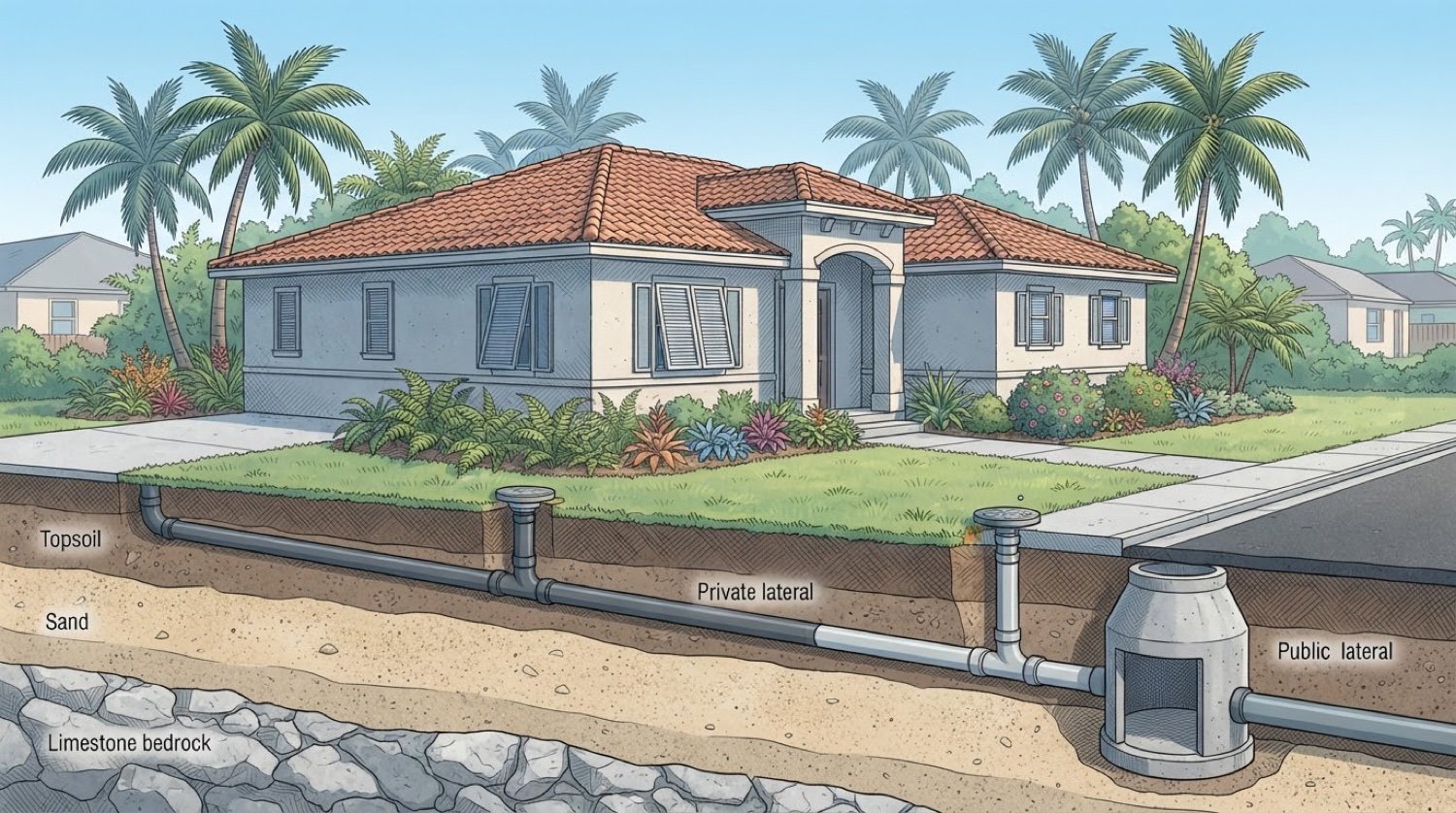
Every home on a public sewer has three pieces:
- The private lateral. WASD defines it as the pipe from your home “up to the property line” or “to a public sewer in a proper easement.”
- The public lateral. This is the short run from the private lateral to the sewer main. WASD says the private lateral “typically has a cleanout located at the property line or at the easement line,” and the public lateral runs from there to the main.
- The sewer main. It runs under the street or in an easement and belongs to the utility.
WASD’s standard layout calls for two cleanouts: Cleanout #1 at the building and Cleanout #2 at the right-of-way or easement line. Cleanout #2 is the usual dividing line, so know where yours is.
Who Is Responsible in WASD’s Service Area
WASD’s Sewer Overflow Response Plan (2015), filed under its federal consent decree, spells out the split:
- You (the customer): “responsible for repair and maintenance of the house connection (i.e., private lateral) to Cleanout #2.”
- Also you: “responsible for keeping the service lateral (i.e., public lateral) free from obstructions to the connection at the public sewer.”
- WASD: “responsible for repairs to the service (or public) lateral.”
In other words, a clog anywhere between your house and the main is generally the customer’s to clear, while a broken pipe on the street side of Cleanout #2 is WASD’s to repair.
New connections are different. WASD’s Utilities Information Request page cites Implementing Order 10-8, section 3.02(3), which says “the customer shall be responsible for the installation and connection from the sewer main to the facilities within the customer’s property.” So a brand-new lateral is the owner’s job for the whole run.
WASD’s November 2026 grease reminder agrees: “If a backup occurs on private-side infrastructure, repairs are the homeowner’s responsibility.”
What This Means for a Backup
WASD’s consent decree says a backup caused by WASD’s system is a “Building Backup,” but a backup “caused by blockages, flow conditions, or other malfunctions of a Private Lateral is not a Building Backup.”
According to WASD’s response plan:
- WASD’s Communications Center screens each call. If the cause is in the private lateral or house plumbing, WASD advises you to call a plumber.
- WASD bills the customer for service calls that turn out to be the customer’s responsibility.
- If a plumber correctly finds that the problem needs a public lateral repair, the plan says WASD repairs the public lateral and the County reimburses “all reasonable plumbers’ fees associated with identifying the lateral repair need.” Confirm the current process with WASD before counting on it.
What This Means for Tree Roots
Roots find their way into cracked or loose joints. On a WASD connection:
- Roots in your private lateral are yours to fix.
- Roots clogging the public lateral fall under your duty to keep it “free from obstructions.”
- Roots that broke the public lateral point to a public lateral repair, which is WASD’s job.
Who to Call First: A Step-by-Step Check
- See if it’s just your home. If several fixtures back up at once, the problem is likely in the main line out of the house. Our post on multiple slow drains explains why.
- Check with neighbors and look at the street. If neighbors are backing up too, or a manhole is overflowing, contact WASD through its official contact page. WASD’s contact page lists “sewer line backed-up or overflowing manholes” among the problems to report.
- Don’t pull a cleanout cap to relieve the backup. WASD’s plan notes that opening Cleanout #1 during a backup releases sewage into the yard.
- Find Cleanout #2 near the property line. WASD’s customer notice asks owners to keep it available for inspection.
- If the problem is on your side, call a licensed plumber for the private lateral and house plumbing.
- Not sure where your lateral runs? WASD’s Utilities Information Request service offers a “Sewer Lateral Location” request.
Coral Gables and Other Cities With Their Own Sewers
Not every address in Miami-Dade gets its sewer collection from WASD. The consent decree lists “Volume Sewer Customers”: cities that WASD serves in bulk and that run their own collection systems. That list includes Coral Gables and Bal Harbour, among others, both in our service area.
Coral Gables
The City of Coral Gables says it “owns, operates and maintains the sanitary sewer system components within our city limits.” Under Ordinance No. 2025-10, adopted June 10, 2025 and amending City Code Section 78-101:
- Owners remain responsible for “all laterals located within their private property” and for building new laterals in the public right-of-way.
- The City assumes “the maintenance, repair, and cleaning of all gravity lateral segments located within the ROW.”
- The exception: if the damage is “caused by trees, roots, or vegetation located on private property,” the owner pays for the repair in the right-of-way too.
- Large projects: new construction, major alterations above a cost threshold, or additions of 1,000 square feet or more can require replacing the whole lateral if the Public Works Director finds it necessary.
Everyone Else
Not sure who runs your sewer? Check who bills you for it and ask that utility where its responsibility begins at your address. Homes on septic follow different rules.
How Atlas Plumbing Can Help
Atlas Plumbing Inc. has served South Florida homeowners since 1994 (license CFC1426451). We handle sewer line repairs and replacements on the private side, plus whole-house repiping and residential plumbing work. We serve Coral Gables, Miami, South Miami, Kendall, Pinecrest, Coconut Grove, Westchester, Doral, Palmetto Bay, Key Biscayne and Bal Harbour.
If your drains are gurgling after rain or backing up, we can help you sort out whose side the problem is on.
Frequently Asked Questions
Who pays to fix a sewer line under the street in Miami-Dade?
On a WASD connection, WASD’s response plan says WASD is responsible for repairs to the public lateral, the section between the property-line cleanout and the main. The customer still has to keep it free of clogs.
Is the sewer cleanout at my property line mine or the county’s?
WASD’s plan says the customer maintains the private lateral “to Cleanout #2,” the cleanout at the right-of-way or easement line. Ask WASD to confirm exactly where its responsibility starts at your address.
Who is responsible for tree roots in my sewer line in Miami-Dade?
Roots in your private lateral are your responsibility. On a WASD connection, roots clogging the public lateral fall under your duty to keep it clear, while a broken public lateral is WASD’s to repair. In Coral Gables, the owner pays for right-of-way repairs when roots from private-property trees caused the damage.
Who should I call first if my sewer backs up in Miami-Dade?
If neighbors are affected or a manhole is overflowing, contact WASD through its official contact page. If it’s only your home, call a licensed plumber to check the private lateral. In cities like Coral Gables that run their own sewer, contact the city.
Does Coral Gables fix sewer laterals in the right-of-way?
Yes, with limits. Since June 2025, the city maintains, repairs and cleans gravity lateral segments in the right-of-way. The exception is damage caused by trees, roots or vegetation on private property, which the owner pays for.
Request a Visit
Sewer backing up, or unsure whose line it is? Call (305) 301-7274 or request a visit. You can also reach us through our contact page. We’re open Monday through Saturday, 7 AM to 5 PM, and closed Sunday.
Sources
Rules summarized from official sources as of November 2026. Your utility has the final word on your address.
- WASD Sewer Overflow Response Plan (2015)
- Miami-Dade WASD consent decree
- WASD Utilities Information Request
- WASD “All You Need To Know” brochure
- WASD official contact page
- WASD “Can the Grease” release, Nov. 20, 2026
- City of Coral Gables Ordinance No. 2025-10 (Sec. 78-101)
- City of Coral Gables Sewers and Stormwater
Leave a Reply