


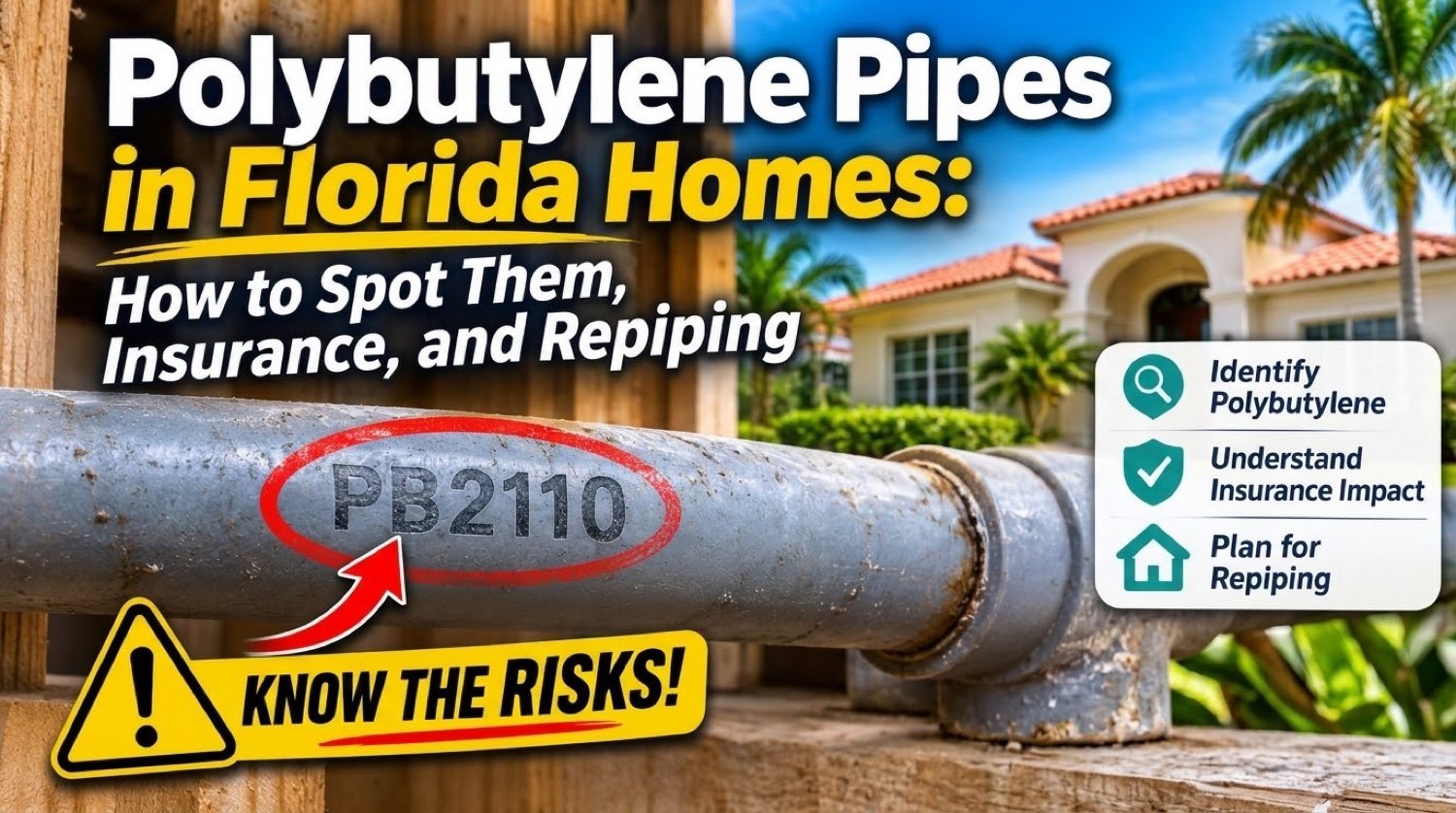
Quick answer: Polybutylene is a flexible plastic water-supply pipe, most often gray and stamped “PB2110,” that was made from 1978 to mid-1995. It can deteriorate from the inside and leak without warning. In Florida it also affects insurance: Citizens won’t write many new policies on homes over 20 years old that have it. Whole-house repiping is the lasting fix.
If you own an older home in Coral Gables, Miami, or anywhere in South Florida, “polybutylene” may first come up during a home inspection or an insurance application rather than from a leak. Here’s how to spot it, why it matters, and what replacing it involves.
What Is Polybutylene Pipe?
Polybutylene (PB) is a plastic that, according to the International Association of Certified Home Inspectors (InterNACHI), was manufactured between 1978 and mid-1995 for home water-supply piping. InterNACHI says it went into up to 10 million U.S. homes during that period. Production stopped in mid-1996 after widespread claims that the pipes were rupturing and causing property damage.
The key point for homeowners: PB carries the water supply to your sinks, toilets, showers, and water heater. InterNACHI notes it was not used for waste, drain, or vent piping, so your drain lines are a separate question.
When Was Polybutylene Used?
Based on those manufacturing dates, polybutylene is most likely in homes that were built or replumbed between about 1978 and the mid-1990s. Homes built earlier can still have it if the plumbing was redone during that window. A home built later is unlikely to have it, but the only way to know for sure is to look at the pipes.
How to Tell If Your Home Has Polybutylene Pipes
You can do a quick visual check without opening any walls. InterNACHI lists these identifying traits:
- Markings: usually stamped with the code “PB2110.”
- Feel: flexible and sometimes curved, unlike rigid copper.
- Color: most commonly gray, but it can also be white, silver, black, or blue. Blue PB was used mainly outdoors, for cold water.
- Size: about ½ inch to 1 inch in diameter.
Where to look
- Under sinks and behind toilets, where the supply lines come out of the wall.
- Near the water heater.
- At the water meter and the main shut-off valve outside the house.
- Where the main supply line enters the home.
Don’t stop at one spot
InterNACHI warns that some copper systems use PB at certain connections, such as where PB meets the short copper “stub-outs” that feed bathroom fixtures. Seeing copper under one sink doesn’t prove the whole house is copper.
Pipes that are easy to confuse with PB
- PEX: flexible and often red, blue, or white; a modern material, not PB.
- PVC/CPVC: white or off-white plastic.
- Polyethylene: flexible and black.
Not sure? A licensed plumber can confirm it. Don’t cut into pipes or walls yourself.
Why Polybutylene Pipes Fail
InterNACHI cites University of Illinois at Chicago studies showing that certain water disinfectants can react with polybutylene and make it flake apart. Small fractures can deepen over time until water escapes. Manufacturers argued that most leaks happen at poorly installed joints and fittings. Either way, for a homeowner:
- Failure starts inside the pipe, so you can’t judge its condition from the outside.
- Leaks can happen without warning and cause flooding and serious interior damage.
- Pipes behind drywall can leak unnoticed for a long time and lead to mold and water damage.
Polybutylene plumbing also led to class-action lawsuits. A 2004 South Carolina Supreme Court opinion explains that Cox v. Shell Oil was filed in Tennessee state court in June 1995 against Shell Oil and Hoechst Celanese, which made resin used in the pipes. According to the opinion, two nationwide class-action settlements, Cox in Tennessee and Spencer in Alabama, were finalized in November 1995.
Polybutylene and Home Insurance in Florida
This is where many Miami-area homeowners first run into the issue.
Citizens Property Insurance
Florida’s state-backed insurer, Citizens Property Insurance Corporation, says in its polybutylene FAQ (updated Jan. 26, 2026):
- New-business risks over 20 years old with polybutylene piping are not insurable by Citizens under several policy forms, including the HO-3 and HO-8 homeowners forms and the DP-1 and DP-3 dwelling forms.
- Dwellings 20 years old or newer with polybutylene may be eligible if there are no signs of leaks, unrepaired water damage, disrepair, or hazards.
The four-point inspection
According to Citizens’ inspections page, it requires a four-point inspection (roof, electrical, plumbing, and HVAC) for property owner applications on homes more than 20 years old. Citizens’ sample 4-Point Inspection Form asks the inspector to check off the type of pipes, with polybutylene listed as an option, and to note whether the home is original, partially re-piped, or completely re-piped, along with the year.
Other insurers
Private insurers set their own underwriting rules. InterNACHI notes that homeowners with PB “might face higher insurance premiums or be denied coverage entirely.” Ask your insurance agent how your carrier treats polybutylene before your renewal or before you buy.
What Polybutylene Means for Selling or Buying a Home
InterNACHI says polybutylene can reduce a home’s value or prolong its time on the market. In practice, it tends to come up in the same places:
- The home inspection. InterNACHI’s Standards of Practice don’t require its inspectors to determine the existence or condition of polybutylene piping, so don’t assume an inspection will flag it. Ask.
- The buyer’s insurance quote. If the home is over 20 years old, the four-point inspection will record the pipe type.
- Your records. If the home has been repiped, keep the invoice and dates. The four-point form asks for the year and extent of any re-piping.
Replacing Polybutylene With Whole-House Repiping
InterNACHI points out that no regulation requires replacing polybutylene, but it believes replacing it before it fails is far cheaper than cleaning up after a leak. Patching one leaking section leaves the rest of the aging system in place, which is why whole-house repiping is the usual long-term answer.
Atlas Plumbing Inc. does whole-house repiping for homes in Coral Gables and the Miami area. Request a repiping visit and we’ll walk you through the process. Here’s what it generally looks like:
- Confirm the material. We check the visible supply lines and connections to see whether you have PB and where it runs.
- Plan the new lines. We map out how the new supply lines will reach each fixture and the water heater, and go over the replacement material with you.
- Get a written estimate before any work starts.
- Replace the supply lines and connect every fixture.
- Test the system for leaks and pressure before we’re done.
- Keep the paperwork. Your invoice documents the re-pipe for your insurer and any future buyer.
Licensed since 1994 (CFC1426451), Atlas has served South Florida homeowners for more than 30 years. Polybutylene is a water-supply issue. If it’s your drains that are acting up, our post on multiple slow drains covers that side of your plumbing.
Areas We Serve
Atlas Plumbing Inc. serves homeowners in Coral Gables, Miami, South Miami, Kendall, Pinecrest, Coconut Grove, Westchester, Doral, Palmetto Bay, Key Biscayne, and Bal Harbour. See all of our residential plumbing services.
Frequently Asked Questions
How do I know if my house has polybutylene pipes?
Look at the supply lines under sinks, behind toilets, near the water heater, and at the water meter and main shut-off. Polybutylene is flexible, usually gray (sometimes blue outdoors), about ½ to 1 inch across, and often stamped “PB2110.” If you’re unsure, have a licensed plumber confirm it.
When were polybutylene pipes used in Florida homes?
Polybutylene was manufactured from 1978 to mid-1995, and production stopped in mid-1996. Homes built or replumbed in that window are the most likely to have it, but any older home could have PB if it was replumbed during those years.
Can I get homeowners insurance in Florida with polybutylene pipes?
It depends on the insurer and the home’s age. Citizens Property Insurance says new-business homes over 20 years old with polybutylene are not insurable under its HO-3, HO-8, DP-1, and DP-3 forms, among others. Private insurers set their own rules, so ask your agent.
Are polybutylene pipes illegal in Florida?
We haven’t found any rule that makes them illegal to keep. InterNACHI notes that no regulations require replacing polybutylene, though many plumbers recommend it. The bigger practical issues are leak risk and insurance eligibility.
Should I replace all of my polybutylene pipes or just the leaking section?
Repairing one section leaves the rest of the aging PB in place, and InterNACHI says it can fail at any point in the system. That’s why replacing the whole supply system is the long-term fix. A plumber can look at your home and explain the options.
Request a Visit
If you’ve spotted gray “PB2110” pipe, your insurer has asked about your plumbing, or you’re buying or selling an older home, request a visit from Atlas Plumbing Inc.
- Call us: (305) 301-7274
- Hours: Monday–Saturday, 7 AM–5 PM, closed Sunday
- Request a visit online or contact us
Leave a Reply